Why your website should start with questions, not visuals
A website project has an obvious starting point: the design. The colours, the typeface, the layout. The thing you can point at and say that's what we're building.
But the projects that hold up – the ones that don't need rebuilding a year later – tend to start somewhere less visible. With questions.
The website question and the brand question are the same question
At Mar Mar Co., we work at the intersection of brand identity and Squarespace website design. The reason that combination matters is straightforward: one should never be designed without the other in mind.
A website built before the brand is resolved is a website that may need rebuilding. A brand developed without considering how it lives online is a brand that loses something in translation.
For founder-led businesses this isn't an abstract concern. When your name, your thinking, and your reputation are inseparable from what you're building, a website that simply looks good isn't enough. It needs to reflect the structure of what you're actually creating – and it needs to be built in a way that can grow with you.
Start with questions, not visuals
Before any visual work begins, we ask a founder to sit with a short document. Not a form, not a checklist – a set of structured questions designed to surface the thinking behind what they're building.
What problem does this solve? What should someone sense the moment they encounter it? What must it never be mistaken for?
The answers shape everything that follows. Typeface decisions, colour relationships, page hierarchy – none of these are made on instinct or aesthetic preference alone. Each is tested against the foundation we established together before a single visual was considered.
This matters more than it might seem. A typeface carries history and personality. A colour relationship sets an expectation. A page hierarchy tells a visitor what the business thinks is important. These aren't decorative decisions – they're structural ones. Getting them right requires knowing what you're actually building, not just what you want it to look like.
A compass, not a checklist
The questions don't disappear once the design work begins. We return to them.
At the start of a project, we typically develop two design directions – each one grounded in the brief, each one defensible, but each emphasising something different. From there, we narrow it down together with the founder.
What happens in that conversation is often more revealing than the brief itself.
Sometimes a founder is drawn to a direction because of how it looks – and that instinct is worth taking seriously. But occasionally, when we hold it up against the original questions – what should someone sense the moment they encounter this? what must it never be mistaken for? – something doesn't quite align. The visual language is attractive, but it's pulling in a slightly different direction than the intention behind the work.
Other times, it's the brief that needs adjusting. A founder's thinking evolves during a project. What they articulated in week one is sometimes subtly different from what they understand by week three. That's not a problem – it's a sign the process is doing its job.
The questions create a reference point to return to, not a contract to enforce.
What ‘built to scale’ actually means
Scalability is a word that gets used a lot in the context of websites and brand. Here's what it means in practice.
Every site we build uses an 8pt grid system. This creates visual coherence across the site – consistent spacing, proportional layouts, a sense of order that visitors feel without being able to name it. It also means that when the site grows, or when someone else steps in to help, the underlying structure is legible.
When we hand over a project, the website is never the only deliverable. Every build includes an integrated style guide – embedded directly into the site – showing the colour system, typography choices, and how the main elements behave. A training video library walks the founder through how to manage and update their own site with confidence. Where we've added custom CSS, we document it, so that if something is accidentally changed, it can be restored.
The goal is a website that someone else could take over if needed. That's not a failure scenario – it's good design.
For projects that involve branding, scalability starts even earlier. During discovery, we ask whether the founder has other projects or extensions in mind. If they do, that thinking feeds into the design decisions from the start – particularly around typography. Will this typeface support a related wordmark later? Could the system extend to a second offering without losing coherence?
A brand that can only ever be what it is today isn't built for a founder. It's built for a moment.
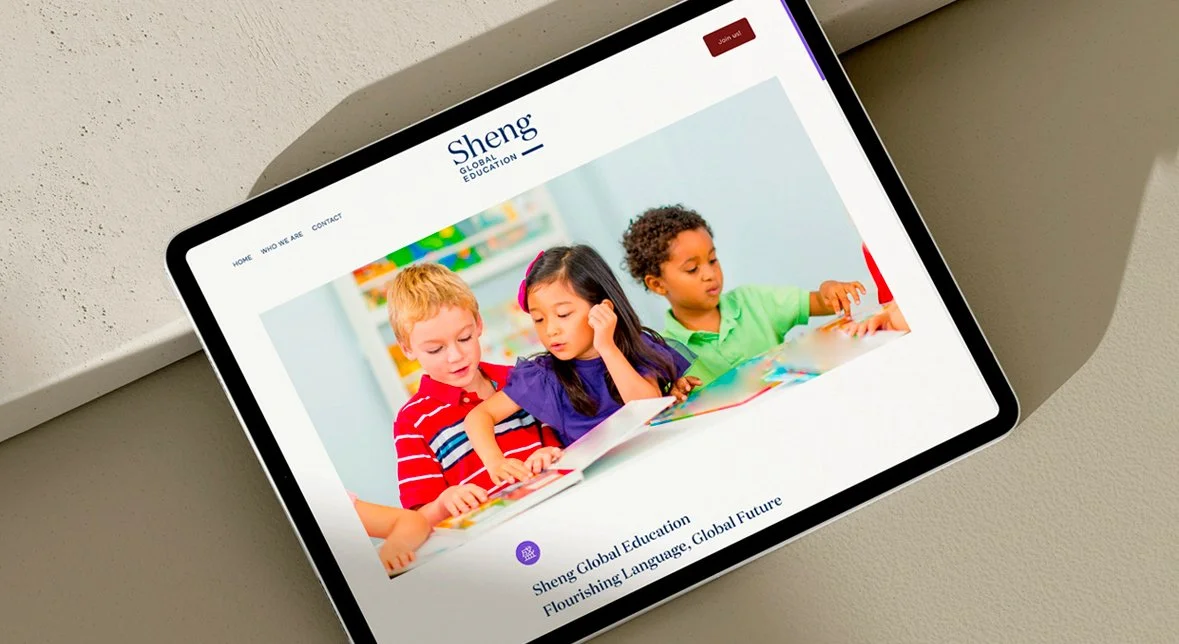
Sheng Global Education – Branding and Squarespace website design
Method and feeling
There's a version of what we do that could sound quite clinical. Questionnaires. Staged processes. Grid systems. Documentation. All of that is real – it matters, and it's what makes the work hold up over time.
But a method is not a design.
The founders we work with don't just need a brand that functions. They need one that feels like them – that carries their character, their particular blend of seriousness and warmth, ambition and humanity. That's not something a process produces on its own. It requires judgment. Sensitivity. And a genuine interest in the person behind the brief.
The tension I work with most often is this: professional versus approachable. Founders want both – and they're right to. Too corporate, and people feel processed. Too casual, and credibility drains away. Holding that balance isn't a technical problem. It's a question of judgment.
This is why I'm drawn to working with founder-led businesses. The brand isn't a layer applied on top of the business – it's an expression of the person building it. When method and feeling are working together, the result isn't just coherent. It's recognisable. You sense there's a person behind it.
Before you start: three questions worth sitting with
Wherever you are in the process – researching, considering, ready to brief – these are the questions that tend to matter most:
What must this never be mistaken for? Knowing what you're not is often clearer than knowing what you are, and it's one of the most useful constraints in a design brief.
Is your brand in a place that feels ready to build from – or is that something you'd like to work through first? There's no wrong answer. Working on brand and website together is often the stronger starting point – each decision informs the other, and nothing gets lost in translation. But knowing where you are before a project begins shapes everything that follows.
What does this site need to do in two years, not just now? The decisions made at the start of a project determine how much freedom you'll have later. A typography system chosen without considering future extensions can close off options that haven't been imagined yet.
Sign up for Studio Notes and download our free checklist: Before You Start. Five areas, a set of prompts to work through at your own pace, and space to write your answers — before you brief a designer or begin a build